Mouriaux designed the brand identity and website for Venari Partners, an executive search firm. The site launched on 1 October 2026. Tested with Google PageSpeed Insights on 22 October 2026, the live site scored 95 for performance on mobile and 97 on desktop, with 100 for SEO on both. Venari's marketing team now edits people, articles and practice pages themselves. The homepage and core pages are built in code; the sections that change sit in a content editor.
Venari Partners is an executive search firm with clients in more than 20 countries. The project ran for about a year with Natasha Pabari and the Venari team, and ended when we handed the website to their marketing team on 30 October 2026.
The work sits under our Modernise Infrastructure service, covering Brand Architecture for the identity, and the website and content system behind it.
In our view, a search firm's website is where a candidate or a client goes to check who they are about to speak to. Most of that weight falls on the people, the practice areas and the articles.
Those parts change regularly. The brand, the page structure and the homepage should not. Open everything up and the site drifts; lock it down and marketing waits on a developer for small edits. So we split it: the team edits what changes, and the code holds what does not, which also keeps performance high.
The brand guidelines start with strategy, not the logo. Venari describes itself as a boutique executive search firm with hubs in London, Milan, the US and the Netherlands. Its core statement is "Executive search for organisations that refuse compromise." Its method has a name, "Pace with Detail": move quickly without losing depth or accuracy.
One of its four pillars is proof over promises. The guidelines point to the Venari Partners Challenge, the firm's expeditions from jungles to summits, as the evidence.
The mark is a V built from three folded planes in green, deep red and orange, beside a widely spaced capital wordmark. It works as a horizontal lockup, a stacked version, or the V on its own as an app icon.
The guidelines give each typeface a job. Urbanist, a geometric sans serif, sets the headlines for a deliberate, architectural look. Cormorant Garamond italic picks out single words within a headline, for contrast and warmth. Inter carries the body text. Photography is black and white: buildings, cranes and people at work.
The site is headless. The code runs on Astro and the content sits in Storyblok, a separate content system. The homepage and the core of the site are written in code. The sections that change over time are connected to Storyblok, where the team edits them: consultant profiles, articles, practice and service pages, testimonials and calls to action.
The pieces are linked. Each article has an author, and each consultant's profile shows the articles they have written. Each person can be assigned a sector, and the site places them on the right pages. A new profile or article starts as a copy of an existing one, so the team fills in fields rather than building layouts.
The Venari Partners Challenge has its own page. Participants are set up as people in the same editor, but their profiles show the charity they support instead of contact details.
We built it through our own production system, which works from the Figma design file. The design and strategy are ours; the system does the production. The same system is the basis of our workflow automation work for clients.
Venari's old site ran on Wix and held 290 historic articles. We used AI to extract the content from the old site and format it for import into Storyblok.
It was not perfect. Some words came across without the space between them, and we are still correcting those. We told the team at handover, so they check an article before reusing it on social media.
These are the live Venari site's PageSpeed Insights scores on 22 October 2026:
The cookie banner costs a couple of performance points.
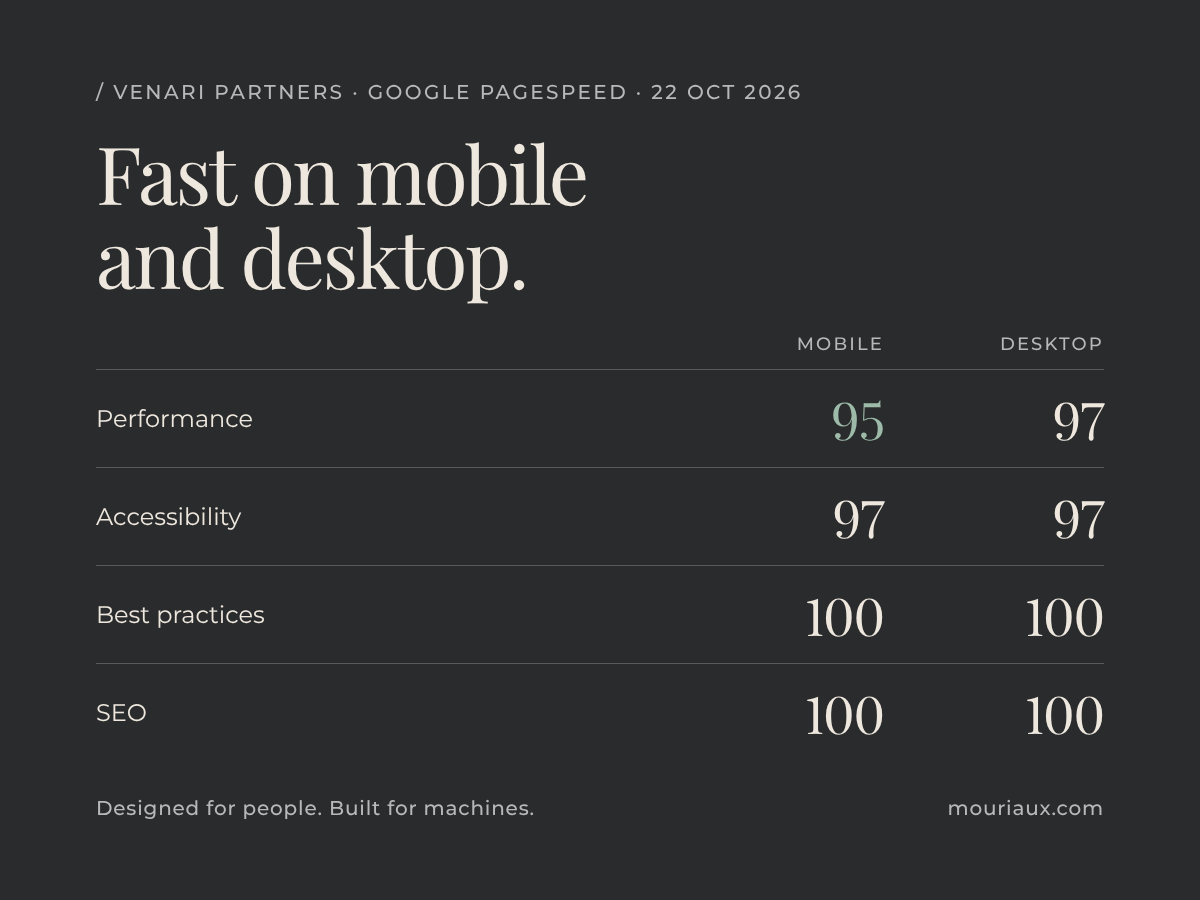
These are lab scores from a test run on one day, not measurements of real visitors. Google explains the difference in its guide to PageSpeed Insights.
We handed the site over on a call with Natasha and David Kershaw, Venari's Senior Marketing Executive, and walked through the editor. The working rules are short:
We followed the call with a recorded video tutorial.
“They understood us as people before touching the architecture, delivering a brand and digital platform that perfectly captures who we are.”
Natasha Pabari, Head of Marketing, Venari Partners
If your marketing team edits the site every week and you also care how fast it loads, a headless build is worth a look. If the site barely changes, it may be more than you need, and we will say so. You can read more about how we build on the Modernise Infrastructure page, or email studio@mouriaux.com.
Written by Tom Le Mesurier, Principal, Mouriaux.